
For years, I have met countless patients who come to me feeling trapped by their diagnosis.
They tell me, “Doctor, I have diabetes… it runs in my family,” or “I’ll have to take tablets forever, won’t I?”
But here’s the truth: Type 2 diabetes is not a lifelong sentence. It is a condition that can be understood, managed, and, in many cases, reversed. This article is my attempt to explain everything you need to know about Type 2 diabetes -what causes it, what fuels it, and what truly helps it heal.
What Exactly Is Type 2 Diabetes?
Type 2 diabetes is not primarily a disease of high blood sugar - it is a disease of insulin resistance.
Insulin is a hormone made by your pancreas. Its job is simple but vital: It acts as a key that unlocks your cells, allowing glucose (sugar) to enter and be used for energy.When you eat, your blood sugar rises. Insulin is released to move that sugar into your cells.
But over time, due to overexposure to high insulin levels, your cells begin to resist it.Think of it as your cells saying, “We’ve had enough sugar. We don’t need more.” The pancreas then produces more and more insulin to force the sugar in. Eventually, the system breaks down:
Blood sugar remains high
Insulin levels remain high
Fat begins to accumulate ( especially around the liver and abdomen)
This is the true start of metabolic dysfunction.
How Type 2 Diabetes Develops Over Time
The process is slow, often taking years before blood sugar officially crosses the “diabetic” line. It typically progresses through stages:
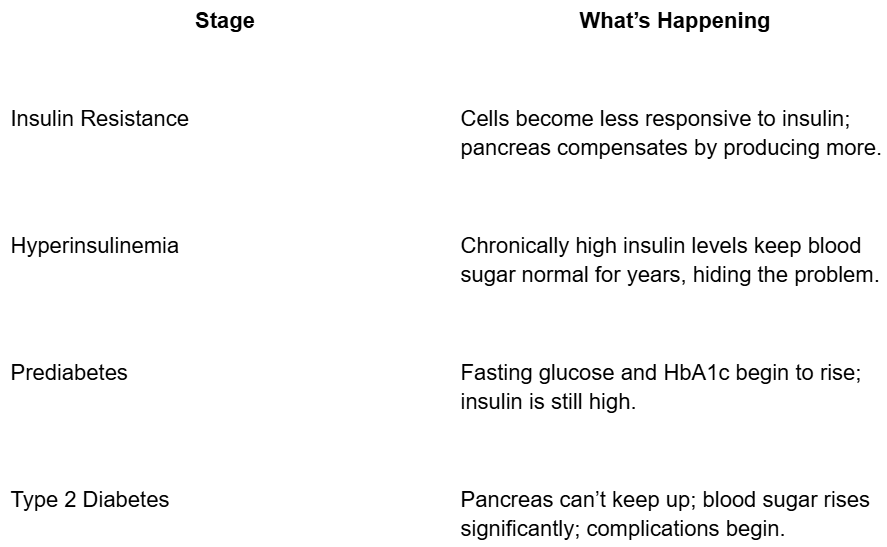
By the time diabetes is diagnosed, the body has been struggling for a long time.
The True Root Causes
Contrary to popular belief, Type 2 diabetes isn’t just about sugar. It’s about too much energy trapped in the body. Key drivers include:
1. Excess Carbohydrate Intake
A diet high in refined carbs and processed foods causes repeated insulin spikes. Over years, this leads to insulin resistance.
2. Frequent Eating
Modern diets promote constant snacking - breakfast, snack, lunch, tea, dinner, dessert. Each eating event triggers an insulin release.
The body never gets a break.
3. Hidden Sugars and Refined Grains
Even “healthy” cereals, breads, and fruit juices can cause blood sugar spikes. These foods act like slow sugar, keeping insulin high throughout the day.
4. Visceral Fat
Fat stored in and around organs (especially liver and pancreas) interferes with insulin signaling, worsening resistance.
5. Sleep, Stress, and Cortisol
Chronic stress and lack of sleep raise cortisol levels which elevate blood sugar and reduce insulin sensitivity.
The Misconception: Treating the Symptom, Not the Cause
Most conventional treatments focus on lowering blood sugar using medication.While this can reduce blood sugar readings, it often does not fix the underlying insulin resistance.
For example:
Sulfonylureas force the pancreas to release more insulin
Insulin injections raise insulin levels directly
Other drugs help the kidneys excrete glucose
In the short term, these help manage sugar levels.But long term, they keep insulin levels high, the very thing that caused the problem in the first place.It’s like trying to treat alcoholism with more alcohol.
To truly reverse diabetes, we must address insulin resistance, not just glucose.
The Science of Reversal
Research now clearly shows that Type 2 diabetes can enter remission. That means normal blood sugar without medications, as long as lifestyle changes are maintained.
There are three major pathways to achieve this:
A. Reducing Insulin Spikes Through Diet
The most effective step is reducing the foods that cause insulin to rise:
Cut out sugar and refined carbohydrates (white rice, bread, pastries)
Focus on low-glycemic, whole-food carbohydrates
Eat plenty of fiber, protein, and healthy fats
Avoid constant grazing. Give your body fasting periods between meals
A low-carbohydrate or intermittent fasting approach, supervised by a doctor, is often very effective.
B. Intermittent Fasting
Fasting gives your body time to lower insulin and burn stored fat.It allows the liver and pancreas to recover from constant overwork.
Popular methods include:
16:8 (16 hours fasting, 8-hour eating window)
24-hour fasts once or twice weekly
Alternate-day fasting, under supervision
Fasting is not starvation .It’s a natural metabolic reset. It helps the body access its own stored energy instead of constantly relying on dietary sugar.
C. Exercise and Muscle Health
Physical activity increases insulin sensitivity.
Even a 30-minute walk after meals can lower post-meal glucose significantly.
Strength training is particularly beneficial because muscle tissue acts like a sponge, absorbing glucose from the blood.
Aim for:
Resistance training 2–3 times a week
Daily movement (walking, climbing stairs, gardening)
Avoiding long periods of sitting
The Role of Stress, Sleep, and Hormones
Healing the body isn’t only about food.
Sleep deprivation increases hunger hormones (ghrelin) and reduces satiety hormones (leptin), leading to overeating.
Chronic stress keeps cortisol high, which maintains high blood sugar.
Mindful relaxation, meditation, and quality sleep are powerful “hidden therapies.”
What About Type 1 and Other Forms of Diabetes?
It’s important to differentiate:
Type 1 diabetes is an autoimmune disease -the body destroys insulin-producing cells. It is not reversible.
Type 2 diabetes, however, is driven by lifestyle and metabolism and can be reversed with proper guidance.
There’s also LADA (latent autoimmune diabetes in adults) a mixed form which requires careful diagnosis.
What Reversal Looks Like in Practice
Patients who achieve remission typically show:
Normal fasting glucose (below 100 mg/dL)
HbA1c below 5.7%
Stable energy and mood
Reduced or no medications
Improved liver function and weight loss
Their blood tests don’t just “look better”. Their metabolic health is better.
A Word on Medications
Drugs like metformin can be supportive, especially early on. However, they should always complement ,not replace lifestyle correction.
Under proper medical supervision, medication doses can often be reduced or discontinued as insulin sensitivity improves.
Diabetes Is Not Your Destiny
Type 2 diabetes doesn’t happen overnight, and it doesn’t need to stay forever. You can think of it as a reversible metabolic condition, not a permanent disease. Your body has an incredible ability to heal when you remove what’s hurting it and provide what it needs. The key is education, consistency, and guidance. Not fear.
As a medical doctor, I’ve seen both sides - patients overwhelmed by their diagnosis, and those who took control of their health and completely changed their metabolic future.
It’s not about perfection; it’s about progress. Even small, consistent changes can restore balance.
So if you are living with diabetes today, I want you to know this: Your future is not written in your diagnosis. You can rewrite it - one meal, one walk, one night of good sleep at a time.